
SUDS LANDSCAPE DESIGN OBSERVATIONS – COWLEY ROAD, CAMBRIDGE (NEAR CAMBRIDGE NORTH STATION)
- R S
- Apr 8
- 2 min read

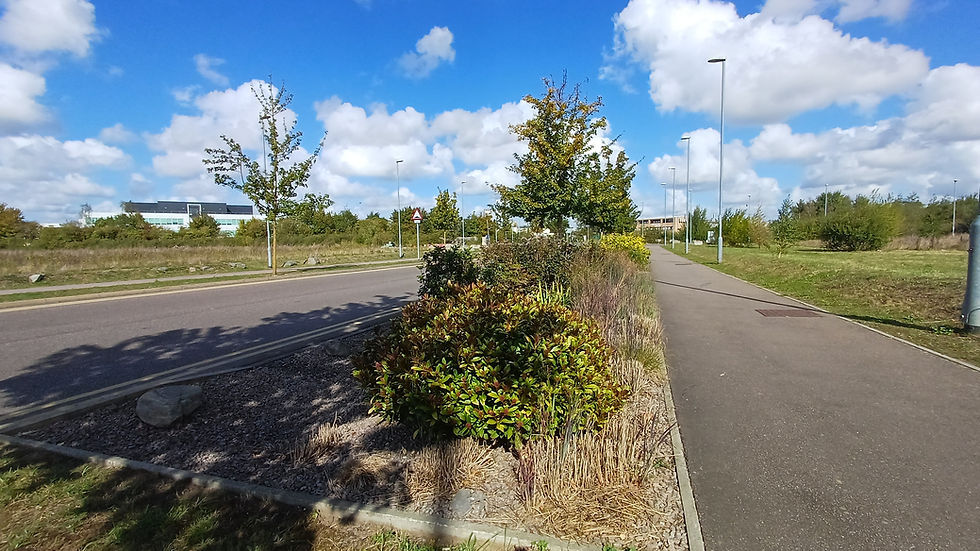
I visited the SuDS landscape along Cowley Road in Cambridge, near Cambridge North Station, as part of ongoing research into urban drainage integration within transport-edge landscapes and public realm design.
The scheme demonstrates a contemporary approach to Sustainable Drainage Systems (SuDS), integrating roadside geometry, tree planting & engineered infiltration zones within a highly urbanised context.
SURFACE WATER MANAGEMENT & KERB DESIGN
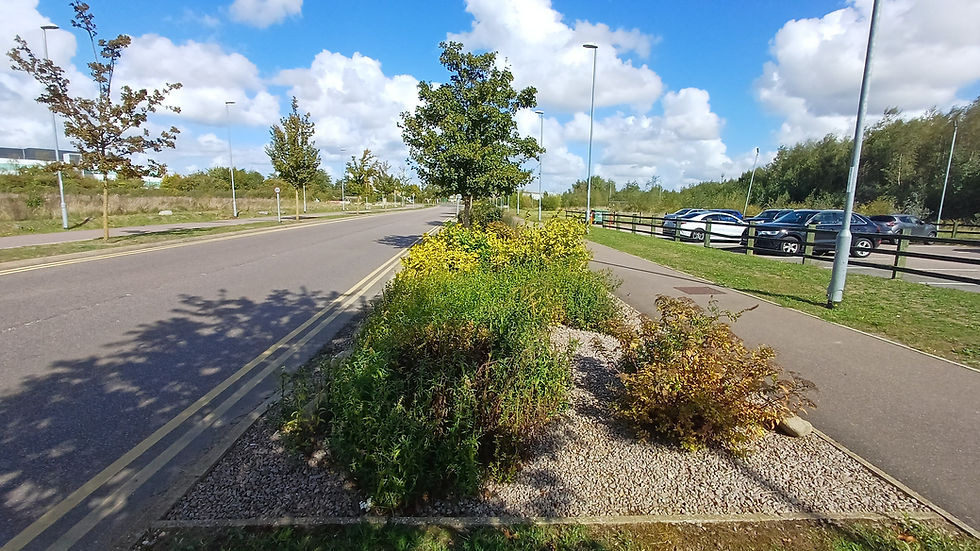
A key feature is the use of modified kerb detailing to direct surface water into adjacent SuDS features.
Photographs show:
- inlets formed through lowered or interrupted kerb lines
- reduced kerb prominence allowing direct runoff entry
- integration of drainage points within the roadside edge
This supports visible water capture & helps manage runoff from impermeable surfaces.
PLANTING STRUCTURE & TREE AVENUE FORMATION
The planting strategy appears based on a single tree species, likely to establish a strong linear avenue over time.
This provides:
- visual consistency along the corridor
- a clear structuring element
- long-term spatial definition through canopy development
However, a single species may limit ecological & structural diversity.
SOIL STRUCTURE & EDGE CONDITIONS
Concrete edging defines soft landscape zones in some areas.
While this protects planting & creates clear definition, it introduces a firm boundary between engineered & soil systems. This may limit permeability & restrict movement of soil organisms such as earthworms, which support soil health.
This reflects the balance between durability & ecological connectivity.
SUDS AGGREGATE & MAINTENANCE CONSIDERATIONS
- Crushed stone is used within SuDS zones adjacent to road edges.
- While supporting infiltration, potential long-term considerations include:
displacement of material into the carriageway
- gradual loss from SuDS areas
- ongoing maintenance requirements
This is typical where drainage systems meet vehicular spaces.
PLANTING DIVERSITY & ECOLOGICAL STRUCTURE
The use of a single tree species supports visual coherence but may limit biodiversity at canopy level.
More diverse planting can:
- support a wider range of species
- improve resilience to pests and disease
- enhance seasonal variation
Here, the design prioritises uniformity & clarity.
LANDSCAPE MATERIALS & SPATIAL DEFINITION
Scattered rock elements are used within some SuDS areas, adding texture to planting & drainage zones.
They act as:
- small-scale visual markers
- reinforcement of SuDS character
Their placement introduces a softer materials within a structured corridor.
REFLECTION
This SuDS scheme demonstrates integration of water management within an urban transport landscape, balancing engineering & spatial structure.
It highlights the ongoing challenge of combining hydrological function, material durability & ecological connectivity within constrained urban environments.
Comments