
HOW HELPFUL ARE TREE & HEDGE PROTECTION SPIRALS & GUARDS
- R S
- 3 days ago
- 3 min read

In my previous journal post, Hedgerows in the British Landscape: Ecological Corridors, Biodiversity and the Importance of Long-Term Stewardship I expressed the vital role hedgerows play as ecological networks, supporting biodiversity, sheltering wildlife and strengthening landscape resilience.
One issue I touched on only indirectly, is the widespread use of plastic tree spirals and guards in woodland planting and hedgerow establishment. These seemingly simple protective measures have become almost standard practice in UK Landscape planting schemes. Yet their long-term impacts on plant health, landscape character, and environmental quality are increasingly difficult to ignore.
The intention: protection and establishment
Tree spirals and guards are typically installed to:
Protect young trees from browsing by rabbits, deer and livestock
Reduce mechanical damage caused by strimming and mowing activities
Facilitate early establishment of planting
In principle, these are valid objectives, particularly in exposed rural sites.
The reality of their use and management on the ground is more complex.
Spirals and guards as landscape litter
One of the most visible issues is the longevity of plastic spirals in the landscape.
While intended as temporary protection, they are frequently:
Left in place far beyond their functional lifespan
Fragmented by UV exposure and frost
Dispersed as microplastics into soil systems
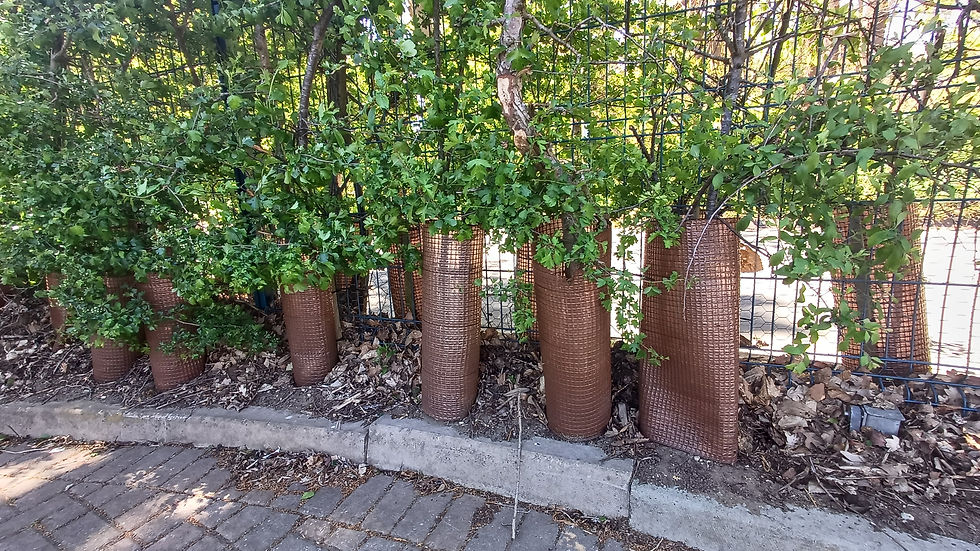
When left unmanaged, spirals visually degrade the quality of rural and designed landscapes especially, where plants should knit into a continuous ecological and visual corridor. Remnants of spirals often become long-term litter embedded within vegetation structure. This undermines ecological integrity and landscape character.
Spiral and guard impact on plant health
A less visible but more serious issue is the physical impact on the trees and shrubs themselves.
As stems thicken, poorly maintained or unmanaged spirals can:
Constrict growth causing girdling
Rub against the bark, causing abrasion in windy conditions.
Create entry points for disease and decay
Distort natural stem form and structural development
What is intended as protection can ultimately affect long-term plant health negatively.
Spirals causing bare stems and trunks
In hedgerow planting, spirals can also contribute to an unintended visual and ecological effect: the formation of bare lower stems.
This occurs when:
Spirals inhibit low lateral growth
Browsing pressure is then focussed above or around protected stems
Light and airflow are restricted at lower levels
Plants fail to thicken and knit into a dense base
The result is a hedgerow that may survive, but does not function optimally as:
A wildlife corridor
A wind buffer
A visually continuous landscape element
Instead, we often see a line of surviving stems with reduced ecological richness at the base layer—precisely where hedgerows should be most active.
Rethinking protection
This is not an argument against protection measures Young planting often genuinely requires intervention to establish successfully.
However, it does raise important questions for designers, contractors, and maintenance teams:
Are spirals being specified with a clear removal strategy?
Is aftercare adequately resourced and enforced?
Are other approaches such as sacrificial planting considered?
Hedgerows are among the most valuable living structures in the British landscape. They are slow, accumulative systems that rely on continuity, density, and care over time. The dilemma we face is prioritising establishment success at the expense of long-term landscape quality. As professionals, we have a responsibility to ensure healthy, resilient, and ecologically functional vegetation. Do our protection methods compromise those qualities? Do we need to reassess the materials we use and the associated management strategy.


Comments